
 2 hours ago
6
2 hours ago
6
Bitcoin is currently consolidating around the $70,000 level as the market continues to trade sideways following several weeks of volatility. Price action has remained relatively stable in recent sessions, with buyers and sellers struggling to establish a clear directional trend while liquidity across the broader crypto market remains constrained.
While the surface-level price movement suggests a period of equilibrium, on-chain data indicates that underlying market pressure may be gradually building. A recent report from CryptoQuant highlights a renewed rise in Bitcoin’s Supply in Loss metric, which measures the percentage of circulating BTC currently held at a loss relative to its acquisition price.
According to the data, Bitcoin Supply in Loss is once again approaching the 40–45% range. Historically, this zone has tended to appear during transitional phases of market cycles, particularly during bear market developments or extended corrective periods.

Previous cycles provide a useful reference point. In 2015, 2019, and again in 2022, expansions in the share of coins held at a loss coincided with periods of increasing market stress. As more investors moved into negative territory, selling pressure often intensified as participants realized losses or reduced exposure during uncertain market conditions.
Rising Supply in Loss Points to Increasing Market Stress
The report also highlights a broader structural signal emerging beneath Bitcoin’s current consolidation. As the Supply in Loss metric continues to rise, a growing portion of the market is beginning to hold coins at a price below their acquisition cost. Historically, this dynamic reflects a weakening market structure, as more investors find themselves in negative territory.
When a larger share of the circulating supply moves into loss, psychological pressure often increases. Some investors may capitulate and sell, while others choose to hold through the downturn. This tension between forced selling and long-term conviction tends to define the middle stages of market corrections.
However, historical data suggests that the current level may not yet represent the most extreme phase of market stress. In previous cycles, major market bottoms typically formed only when Supply in Loss expanded above roughly 50% of circulating Bitcoin. Those moments coincided with widespread capitulation, when a majority of recent buyers were underwater.
At present, the metric approaching the 40–45% range indicates that pressure is building but has not yet reached the levels historically associated with cycle lows.
If previous patterns repeat, the current environment may represent the early stages of a broader bearish phase rather than the final bottom of the market cycle.
Bitcoin Consolidates Below Key Moving Averages After Sharp Correction
Bitcoin continues to trade near the $69,000–$70,000 region following a sharp correction that unfolded earlier this year. The 3-day chart shows BTC attempting to stabilize after a rapid decline that pushed the asset from the $90,000 range down toward the $60,000–$65,000 zone in February, where buyers briefly stepped in to absorb selling pressure.
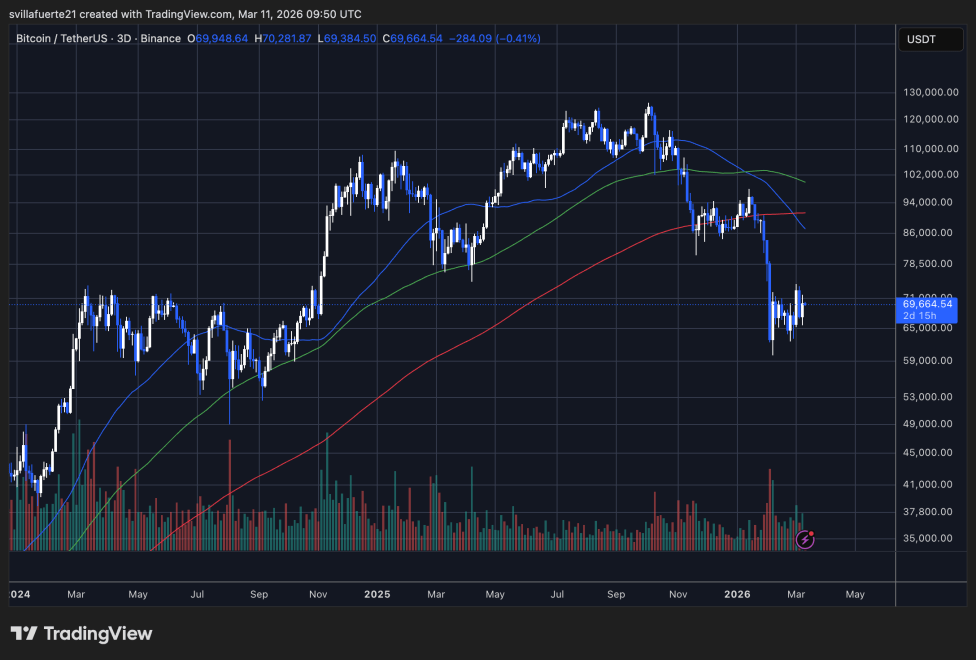
Despite the recent rebound, the broader structure remains technically fragile. Bitcoin is currently trading below its short- and medium-term moving averages, including the 50-period and 100-period trends, which are now sloping downward and acting as overhead resistance. This alignment typically reflects weakening momentum after a strong upward cycle.
The long-term 200-period moving average near the $90,000 region remains the most significant structural level above the market. Losing this trend line earlier in the correction confirmed the shift from an expansion phase into a broader consolidation or corrective environment.
In the short term, price action suggests Bitcoin is forming a range between approximately $65,000 and $72,000. The lower boundary of this zone has acted as support during recent pullbacks, while repeated attempts to push above the $72,000 level have struggled to gain sustained momentum.
Until Bitcoin reclaims the $75,000–$80,000 region, the chart suggests the market will likely remain in a consolidation phase.
Featured image from ChatGPT, chart from TradingView.com













 English (US) ·