
 1 hour ago
2
1 hour ago
2
Bitcoin is attempting to climb above the $72,000 level as the market searches for direction following weeks of volatile and largely sideways price action. While buyers have recently pushed the asset higher, the $72K zone continues to act as a key resistance level, limiting upward momentum as traders evaluate both macroeconomic conditions and on-chain signals.
Amid this technical battle, new research from CryptoQuant analyst XWIN Research Japan highlights a notable shift in Bitcoin’s long-term valuation metrics. The report focuses on the Market Value to Realized Value (MVRV) ratio, a widely used on-chain indicator designed to evaluate whether Bitcoin is trading above or below its historical cost basis.
The MVRV ratio compares Bitcoin’s market capitalization with its realized capitalization, which represents the aggregated value of coins based on the price at which they last moved on-chain. By analyzing this relationship, the indicator helps determine whether the average investor is currently holding unrealized profits or losses.
According to the latest data, Bitcoin’s 365-day MVRV ratio has fallen to levels similar to those observed in late 2022 following the collapse of the FTX exchange. During that period, intense market stress pushed many investors into unrealized losses, compressing average returns well below historical norms and marking one of the most difficult phases of the previous market cycle.
MVRV Patterns Suggest Possible Undervaluation Phase
The CryptoQuant report notes that previous periods of depressed MVRV readings have often preceded strong recoveries in Bitcoin’s price. After the sharp market stress that followed the FTX collapse in late 2022, Bitcoin entered a similar valuation zone. In the three months that followed, the asset rallied roughly 67%, marking the beginning of a broader recovery phase.

Historically, such patterns tend to emerge when the MVRV ratio falls significantly below its long-term averages. At those levels, many investors are holding coins at a loss, which often reduces selling pressure as weaker hands have already exited the market. In these environments, long-term investors frequently begin accumulating positions as the perceived risk-reward balance improves.
However, the current market environment differs from the conditions observed in 2022. The previous downturn was largely driven by internal shocks within the crypto industry, including major bankruptcies and liquidity crises. Today, broader macroeconomic forces play a more dominant role, particularly elevated interest rates and tighter global liquidity conditions.
At the same time, the structure of the market has evolved. Institutional participation has increased significantly through the introduction of spot Bitcoin ETFs and growing corporate accumulation strategies.
Although MVRV does not guarantee an immediate price reversal, the report suggests the current compression in valuation may represent a critical phase for assessing Bitcoin’s longer-term trajectory.
Bitcoin Tests Resistance Near $72K After February Rebound
The chart shows Bitcoin trading around the $72,000 level as the market attempts to recover from the sharp correction that occurred earlier in 2026. After reaching highs above $120,000 during the previous cycle phase, BTC entered a sustained downtrend marked by a sequence of lower highs and increasing selling pressure across several months.
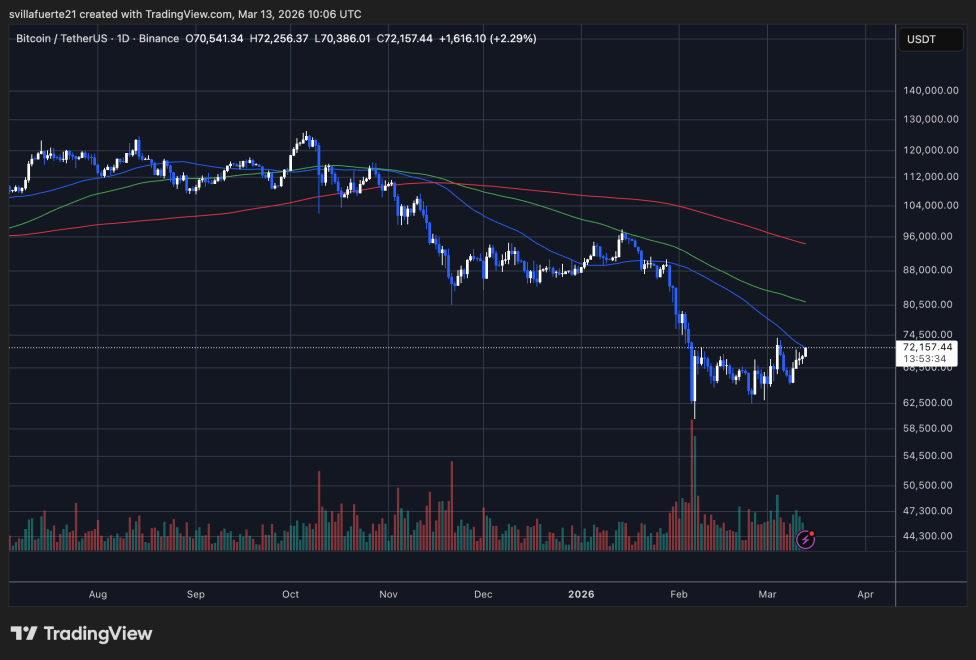
The most significant move in the recent structure occurred in early February, when Bitcoin experienced a rapid sell-off that briefly pushed the price toward the $60,000 region. The drop was accompanied by a strong spike in trading volume, suggesting forced liquidations and aggressive selling across the market.
Following that capitulation-like event, Bitcoin began to stabilize and form a short-term recovery structure. Over the past several weeks, the price has gradually moved higher, reclaiming the $70,000 zone and approaching the $72,000 resistance level.
However, the technical structure still shows important challenges ahead. Bitcoin remains below its key moving averages, which continue to slope downward and signal that the broader trend has not yet fully reversed.
The $72,000–$74,000 area now represents a critical resistance range. A successful breakout above this zone could open the door for a broader recovery toward higher levels, while rejection here may lead to renewed consolidation as the market continues searching for directional momentum.
Featured image from ChatGPT, chart from TradingView.com












 English (US) ·