
 1 hour ago
1
1 hour ago
1
Ripple’s chief legal officer Stuart Alderoty says the SEC’s latest crypto guidance does more than clarify policy. In his reading, it effectively cements what Ripple has argued for years: XRP is not a security, but a digital commodity.
The comment came after the US Securities and Exchange Commission said it had issued “an interpretation that clarifies the application of federal securities laws to crypto assets,” calling the move “a major step” toward giving markets, investors and innovators more clarity.
Ripple’s Top Lawyer Reacts
Alderoty quickly tied that announcement to Ripple’s long-running legal fight with the agency, writing via X: “We always knew XRP wasn’t a security – and now the SEC has made clear what it is: a digital commodity. Grateful to the Crypto Task Force for working to deliver the clarity that markets, investors, and innovators have long deserved.”
We always knew XRP wasn’t a security – and now the @SECGov has made clear what it is: a digital commodity. Grateful to the Crypto Task Force for working to deliver the clarity that markets, investors, and innovators have long deserved. https://t.co/jJ7QTUiJbJ
— Stuart Alderoty (@s_alderoty) March 18, 2026
That framing matters because it pushes the conversation beyond the narrower question of whether XRP sales can fall within securities laws in certain contexts. Alderoty’s post suggests Ripple sees the SEC’s latest interpretation as broader validation of the company’s core position: that XRP itself should be treated as a commodity-style crypto asset rather than a security instrument.
Notably, the Commission’s new guidance defines how federal securities laws apply to crypto assets. Even so, the market reaction around XRP was immediate, with several legal commentators and crypto experts reading the move as a meaningful shift in the regulatory ground beneath the asset.
Among the strongest reactions was from pro-XRP lawyer Bill Morgan, who linked the development directly to the Ripple case and Judge Analisa Torres’ reasoning. “So Judge Torres’ reasoning in SEC v. Ripple about XRP was 100% correct and is now accepted by the SEC in relation to most cryptos,” Morgan wrote.
Chad Steingraber wrote, “We have the official list of Digital Commodities from the SEC,” then named a group of tokens which are included as examples inside the SEC document: APT, AVAX, BTC, BCH, ADA, LINK, DOGE, ETH, HBAR, LTC, DOT, SHIB, SOL, XLM, XTZ and XRP.
Luke Martin pushed the bullish interpretation further, arguing that “If XRP isn’t a security, nothing is a security. Unfathomably bullish.”
For XRP holders and Ripple supporters, the significance lies not only in the SEC’s updated crypto guidance, but in the fact that Ripple’s legal win appears to have gained another regulatory seal of approval, cementing XRP’s standing as a digital commodity.
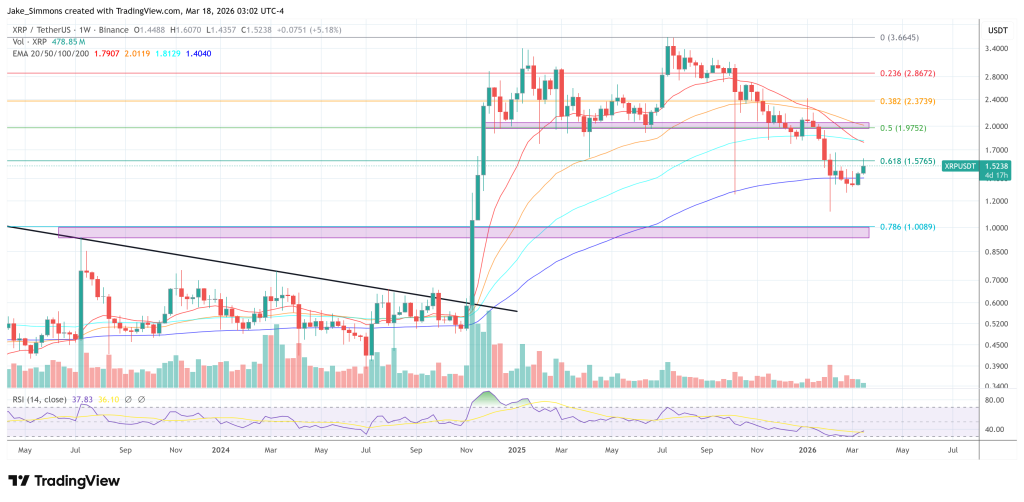
At press time, XRP traded at $1.52.










 English (US) ·